What Happened at Babi Yar? Fact vs. Myth
By Michael Nikiforuk
Aerial reconnaissance photos taken before and during World War II show mass graves of victims of the Soviet Cheka/NKVD, but an absence of Jewish mass burials.
What, if anything, happened at a place called Babi Yar (Old Woman’s Ravine) near Kyiv (Kiev), Ukraine in September of 1941? According to official histories and inscriptions on monuments, 250,000 people, mostly Jews, were killed by the Nazis there. But if thousands of Kyivan Jews (those not evacuated by the Soviets) were killed in September of 1941 by the Germans, they were not murdered or buried at Babi Yar. This fact was revealed in aerial reconnaissance photos discovered in the U.S. National Archives in Washington, D.C.
In February of this year, a Ukrainian court threw out a case brought by Ukrainian Jews against V. Kretytnychy of the St. Andrew Society and E. Musiyenko, editor of the Kyiv Evening News, who challenged the official Babi Yar story. Encouraged by the court decision, on March 19, the Kyiv Evening News published a four-page story setting the record straight for the first time since the Allies condemned the phony “atrocity” during World War II.
What is now coming to the fore is incontrovertible proof that no massacre took place at Babi Yar during the German occupation of Kyiv; that the ravine was not used as a mass grave for Jews killed by the Germans. But it was a burial field between 1922-1935 for the victims of the Cheka/NKVD.
For decades, aerial photography has been recognized as an indispensable archeological tool. With sophisticated equipment, ruins of ancient cities and cemeteries that lie under cultivated fields, forgotten for decades or centuries, have been discovered. Even submerged Hellenic ports have been discovered by aerial photography.
In 1991, wartime aerial photographs from the National Archives in Washington, D.C. were used as the ultimate guidance in exhumations of hundreds of Polish officers and intellectuals massacred in 1939-1940 by the Soviet NKVD in the vicinity of Kharkiv. Aerial photos of Kyiv’s distant suburbs, including
Bykivnia, Bilhorodka and Darnista, revealed mass graves of victims of the 1930s Stalinist terror-famine. It is therefore logical to assume that aerial photos of a ravine would reveal evidence of recent mass graves or of a major topographic disturbance.
The U.S. National Archives in Washington contain about 1,100,000 wartime aerial photos, among them some 600 of Kyiv, including Babi Yar. They were taken during 20 or more flights over the area. The first photos, taken at 12:23 p.m. on May 17, 1939, reveal such details as cars and even the shadows of the lamp posts on the streets of Kyiv. Every large bush and small tree is visible on the slopes and at the bottom of Babi Yar ravine. The last aerial photo coverage of Kyiv (and Babi Yar) took place on June 18, 1944, about nine months after the city’s “liberation” by the Red Army.
This series of reconnaissance photos demonstrates that the flora and the ground cover of the ravine remained undisturbed throughout the two years of German occupation. When the early and late photos are compared, it is obvious that the scattered trees grew and became slightly larger. No evidence of human or large animal activity in the ravine can be discerned on the many aerial photos of Babi Yar taken repeatedly in different seasons of the years 1939-1944.
In November of 1943, a group of Western journalists, including New York Times correspondent William “Bill” Lawrence, himself Jewish, were invited to Kyiv by the Soviets. This occurred two weeks after the city’s fall to the Red Army. The reporters were told that this was only six weeks after
the Germans had completed the dynamiting, disinterment and open-air cremation of 70,000 corpses, followed by the crushing and bulldozing of the unburned bones into the soil of the ravine.
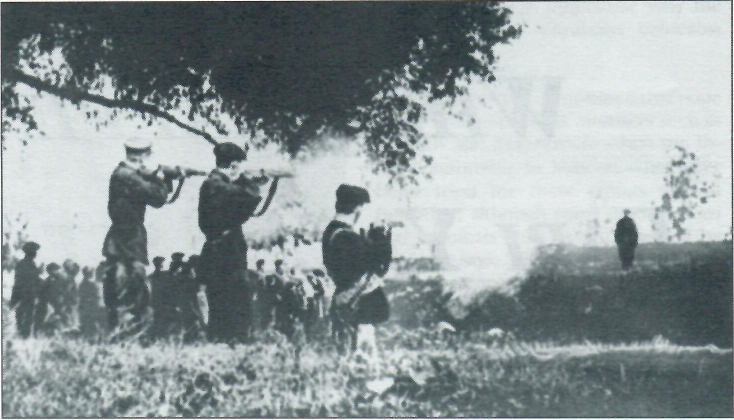
But the Western journalists were hard pressed to find any convincing physical evidence at the site of the alleged massacre.
The lack of reliable physical evidence of this “greatest massacre of World War II” and the inability to find a single inhabitant of Kyiv willing to corroborate the story impelled the NKVD to provide the Westerners with three “eyewitnesses.” Even though a Times editor censored out the most egregious exaggerations (about Soviet partisans and German “gassing vans”), the disjointed story by these three liberated Soviet POWs became the template for imitation for all subsequent Babi Yar testimonies.
When one realizes that all Soviet POWs were facing either a firing squad or a short-lived future in the Gulag (it was a capital crime in the USSR for a soldier to be captured alive by the enemy), one realizes why it was easy for the NKVD to coerce any expedient statement from them.
Two weeks later, Soviet authorities were able to orchestrate massive “grass roots” support for their three Babi Yar witnesses. According to the “front pages of Moscow newspapers,” (as reported in
the United States), “40,000 Kyiv residents [sent a letter] to Premier Josef Stalin, raising the estimate of the number killed and burned in the [Babi Yar] ravine to more than 100,000 (New York Times, December 4, 1943).
Since in later years only 11 of these supposedly well-informed citizens offered any testimony, the wartime statistical reports in the New York Times regarding Babi Yar (as well as the subsequent testimonies of belated witnesses) may be considered baseless.
By 1943, the NKVD had a well earned reputation for its ability to obtain any testimony from almost any witness. For instance, in August of 1941, the Soviet press agency TASS and the Associated Press reported as fact the testimonies of NKVD-provided witnesses to the effect that the massacre of about
4,000 Ukrainians in NKVD prisons in the city of Lviv in late June of that year “was committed by the Nazi Storm troopers.” This in spite of the fact that Lviv had not been taken by the Germans until July 1, 1941.
Long famous testimony extorted by the NKVD from a large number of witnesses told of the mass murder of 4,500 Polish military officers and intellectuals by the Nazis in the Katyn Forest. These fraudulent testimonies, taken under oath in the fall of 1943, were finally refuted by the Russians in the spring of 1990. However, this admission was not forthcoming until the German pre-invasion aerial reconnaissance photos of Katyn (showing the mass graves of the Polish officers, teachers, etc.) had been transmitted in the fall of 1989 to the Soviet authorities.
Chronology suggests that the NKVD provided Western correspondents with three Soviet ex-POWs as witnesses of the Babi Yar massacre to test their credibility under scrutiny by non-Soviets. In 1943, the Babi Yar massacre, being almost unknown in the West and thus unimportant, was apparently selected by the NKVD for such a “dress rehearsal,” prior to the contemplated exposure to Western journalists of fraudulent Katyn massacre witnesses in this far more publicized and more politically important affair.
As a result of the failed Babi Yar credibility test for their ex-POWs, the Soviets for 25 years did not provide access to live “eyewitnesses” of massacres to Western correspondents in Katyn or elsewhere.
Furthermore, the Soviets postponed the inspection of Katyn by Westerners for four months, from September 29, 1943 to January 24, 1944, until the site and the physical evidence were covered by snow and literally frozen, as was the reporters’ investigative zeal in the unheated tents provided them.
Among the observers of the work of the Soviet investigative commission was 25-year-old Kathleen Harriman (daughter of then-U.S. Ambassador to Moscow W. Averell Harriman) who, in her naiveté, later became (along with her father) a champion of Soviet credibility. On the other hand, the more experienced Lawrence from the New York Times, who was also present, was even more skeptical in his Katyn report about presented evidence than in his earlier Babi Yar story. As a result, his Katyn report was spiked and never published.
Thus, the false testimony of the NKVD-provided eyewitnesses of the alleged Babi Yar massacre became the cornerstone of a decades-long Soviet judicial policy of not allowing their fraudulent atrocity witnesses to testify independently; that is, beyond the reach of the supervising Soviet prosecutor, or outside the borders of the USSR.
Soviet archival records reveal that the atrocity propaganda about Katyn and Babi Yar was fabricated by Ilya Ehrenburg and Vasily Grossman, who also invented and reported the now discredited victim counts of Nazi concentration camps: 4 million at Auschwitz; 1.5 million at Majdanek and 3.5 million at Treblinka.
Even at the Nuremberg Trials, the Soviets did not provide to Western authorities or correspondents live eye-witnesses to any German massacres, including Babi Yar and Katyn. Instead, Soviet Prosecutor Col. Smirnoff peddled—but without much success—fabrications in the form of affidavits about the two alleged German massacres. Also, Ilya Ehrenburg (Erenburg), in his 1947 novel The Storm, tried unsuccessfully to revitalize the Babi Yar story.
The Old Women's Ravine story did not gain “credibility” until 12 years later. Then, a visiting Jewish-Ukrainian-American journalist, Joseph Schechtman, persuaded young Soviet dissident Evgeny Yevtushenko to write an emotional and widely read Babi Yar poem.
But poetic fancy cannot stand against physical evidence. Indeed, the aerial photos of the Ahovtnevyi borough of Kyiv and the general area of Babi Yar reveal the presence of a row of about 10 mass graves, some 165 yards behind the western fence of Kyiv's labor camp, Syretz. These could contain up to 1,000 victims of the camp buried over the two years of the German occupation of Kyiv. Furthermore, at the nearby small Orthodox Lukianivsky cemetery, another, larger mass grave can be seen. This could contain up to 2,000 bodies of the frequent public or surreptitious German executions of resistance fighters in Kyiv.
On this subject, according to the Hague Convention (1905) and the Geneva Convention (1920) on the conduct of civilians during wartime, taking part in hostilities without easily visible, external symbols of belonging to military units is subject to immediate execution.
A number of additional, overlooked historical facts undermine the credibility of the standard tale propagated about Babi Yar today. For one thing, the Babi Yar massacre was not mentioned in the Ukrainian Resistance press, although the killing of its members by the Germans in Kyiv is described. Secondly, the occurrence of the Babi Yar massacre is excluded, until the late 1970s, from the writings of Ukrainian émigrés (former wartime inhabitants of Kyiv) as well as from Ukrainian encyclopedias; some published by Western universities. Thirdly, and perhaps most importantly, for decades the Babi Yar massacre did not catch the literary attention of Kyiv's Jewish population.
The expatriates of about 440 Jewish communities of the USSR were able to produce commemorative books (Yizkerbikhers) about their districts, cities, towns and even villages. But not until 1981 was the first scarce, commemorative book published in a small edition about the Ukrainian capital, Kyiv; in Israel in Hebrew. An expanded Yiddish (spoken almost exclusively by German Jews) version came out again in a limited edition in the U.S. in 1983. If the massacre at Babi Yar were true, how could 150,000 surviving, educated Kyivan Jews have been so tardy in recording the destruction of their kinsmen?
On the occasion of the 50th anniversary of the alleged Babi Yar massacre, the world’s media was replete with reports of the exact number (33,771) of Jews machine-gunned there. They variously reported its timing as taking 48, 36 or 24 hours. However, they rarely mentioned that the suspiciously exact number of victims were derived from captured German documents (so-called “Einsatzgruppen Reports”) and were completely silent about the fact that these purportedly “exact” reports failed to indicate Babi Yar as the site of the massacre.
The media also failed to mention that almost every major historian, including Holocaust expert Prof. Raul Hilberg, considers the atrocities mentioned in these reports as exaggerated.
The wartime aerial photos of Kyiv provide incontrovertible proof that the so-called historic documentation of the Babi Yar massacre represents fabricated wartime propaganda and post-war martyr mythology. Perhaps the Nazis had, as promised, deported the missing Kyivans away from Kyiv. If so, their remains and burial sites should be sought elsewhere.
On the other hand, what may have happened at Kyiv can be glimpsed from the dispatch of the United States 12th Army Headquarters in Europe, published in, among others, the May 1, 1945 issue of the New York Herald Tribune. It mentions that a captured German doctor, Gustav Schuebbe, confessed to directing an annihilation institute, where “110,000 Were Murdered by Nazi Physicians in Kyiv.” In addition, Schuebbe “admitted he had [himself] murdered about 21,000 persons” with injections, thus apparently outdoing Dr. Mengele, the infamous Auschwitz physician.
So far, no one in the former USSR or from Jewish organizations, has attempted to pinpoint the location of the “German Annihilation Institute” (where the remaining “Jews and Gypsies” of Kyiv were killed, according to the May 1, 1945 issue of the New York Times). Had such a place existed, it would seem that the site of the “Annihilation Institute” would be the proper Kyiv location for the commemorative menorah, erected in 1991 following a visit by then-U.S. President George Bush.
Not until 1966 were Ukrainians implicated in the alleged Babi Yar massacre of Jews. The only witness was an alleged Babi Yar survivor, a Kiev Puppet Theatre actress named Dina Pronicheva. The testimony of this Jewish witness is nullified by the aforementioned absence of any photographic trace of massacre or mass burial. Furthermore, no witness has ever implied the complicity of Ukrainians in acts perpetrated at the never-located German Annihilation Institute of Kyiv.
Following the Soviet Union’s demise, the leaders of the then-newly-proclaimed independent Ukraine—instant converts from communism—were fast to jump on the Babi Yar bandwagon. One of them, Ukraine’s Ambassador to the United Nations, Genadi Udovenko, went so far as to state (Washington Times, Sept. 5, 1991) that “in the first week of the horrible Babi Yar massacre, 50,000 Jews, mostly children, had been slaughtered.”
During the summer of 1941, the Soviets had been able to evacuate about 150,000 Jews from Kyiv, while the Germans were advancing through Western Ukraine. Therefore, the Ukrainian Ambassador’s statement was preposterous and inadvertently defamatory. It suggested that Jewish parents, who had been safely evacuated from Kyiv, had abandoned their children.
Perhaps Ukraine’s current leaders might better serve their people, as well as their post-communist consciences, by exhibiting tangible contrition relative to Communism’s early 1930’s famine-slaughter of unquestionably immense proportions.
Michael Nikiforuk is chairman of the Babi Yar Research Committee. A report on the committee’s findings was first published in 1991 by the Ukrainian Friends of Fairfield Association, 25 Third Street, Stamford, Connecticut 06905; phone (203) 357-7530.